

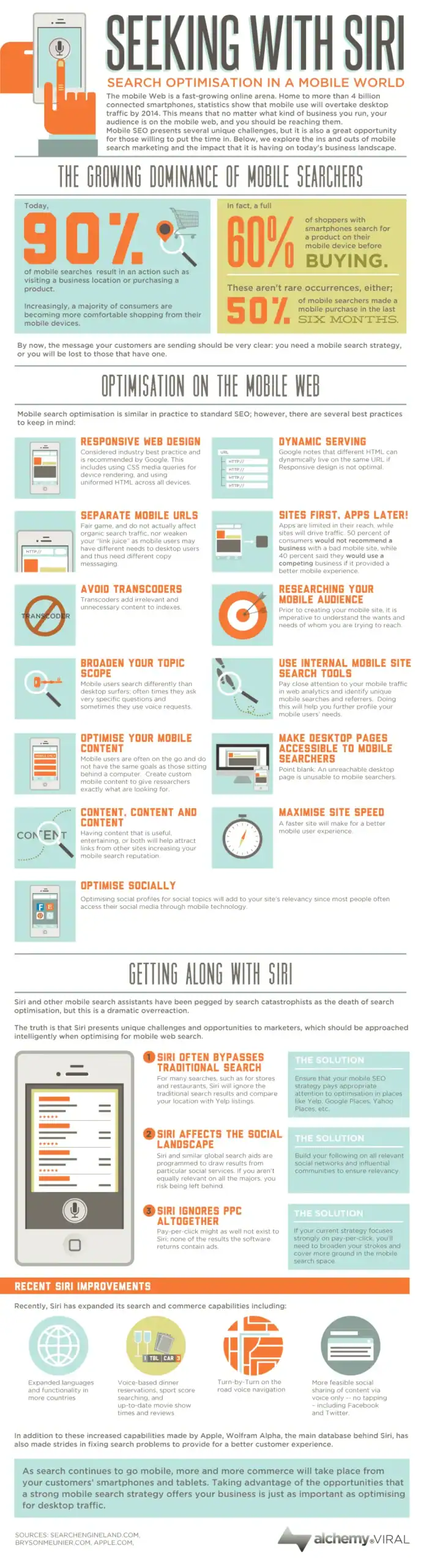
Mobile search has become the primary way customers discover businesses. With billions of people now browsing on smartphones, your mobile experience has a direct impact on your revenue. The infographic above highlights why mobile optimisation is no longer optional. It shows how user expectations, search behaviour, and voice search tools like Siri influence your visibility and conversions.
If your website is not built for mobile users, you could be losing traffic, leads, and sales without even realising it.
Below, we break down the key insights from the infographic and explain why the mobile experience gap matters today more than ever.
1. Mobile Searchers Are Ready to Buy
The infographic shows that 90% of mobile searches lead to an action, such as a call, a store visit, or a purchase. Mobile users have urgency. They search with intent.
Even more important:
- 60% of shoppers use their phone to search before buying.
- 50% make a mobile purchase within six months.
These behaviours make the mobile experience a high-stakes moment. If your site loads slowly, is hard to navigate, or lacks clarity, users will leave and choose a competitor who offers a smoother experience.
2. Your Website Structure Matters More on Mobile
Good mobile SEO starts with good mobile design. The infographic outlines several core fundamentals:
Responsive design
Your website must adjust seamlessly across devices. This includes clean CSS, properly sized images, and readable typography.
Fast-loading pages
Mobile users expect instant results. The slower the site, the higher the abandonment rate.
Clear, simplified content
Short paragraphs and scannable sections improve engagement. Mobile visitors should quickly understand what you offer and how to take action.
Easy navigation
Menus must be simple. URLs should be short and descriptive. Buttons must be big enough to tap without frustration.
A well-structured website helps both search engines and users find what they need with minimal friction.
3. Understand Your Mobile Audience
The infographic highlights how mobile search patterns differ from desktop behaviour. Many users rely on voice commands, conversational search, and quick answers.
This means your mobile strategy should include:
- Understanding what your audience searches for
- Answering questions clearly on your site
- Using headings that match natural language queries
- Reviewing analytics to identify mobile-specific traffic and behaviour
When your content aligns with your users’ needs, engagement improves and drop-off declines.
4. Optimise Your Content for Mobile Search
The infographic reinforces how important it is to tailor content to mobile visitors. This means:
- Prioritising important information at the top of the page
- Using concise language
- Adding schema markup for clarity
- Keeping visuals lightweight so they don’t slow down the page
Rich, useful content drives mobile traffic and enhances search relevance.
5. Social Signals Influence Mobile Search Visibility
Since most people access social media on their phones, local activity and social engagement play a key role. Optimised social profiles create stronger visibility signals and support mobile SEO. The infographic also points out that socially relevant topics boost your perceived credibility in mobile search results.
6. Siri and Voice Search Are Changing How People Discover Businesses
Voice assistants now play a major role in mobile search. According to the infographic:
- Siri often bypasses traditional search results
- Siri draws heavily from social sites and map listings
- Pay-per-click ads may not appear at all in voice-driven results
This means your mobile experience must work well beyond your website. Ensure you are fully optimised on platforms like Google Business Profile, Yelp, Apple Maps, and other location-based services.
Voice search optimisation increases your reach in a landscape where typing is becoming less common.
7. Mobile Improvements Lead to Immediate Business Growth
As the infographic points out, recent updates to Siri and other mobile technologies have made mobile search even more sophisticated. From expanded languages to better navigation tools and smoother content sharing, customers now expect a fast, seamless mobile experience.
Businesses that prioritise mobile optimisation see:
- Longer browsing sessions
- Higher conversions
- Better search rankings
- Lower bounce rates
- Increased customer trust
- These are direct indicators of revenue growth.
- Bridging the Mobile Experience Gap
Your website may look great on desktop, but if it fails on mobile, it is costing you opportunities. The mobile experience gap shows up in slow load times, confusing layouts, missing information, and poor local optimisation.
- A strong mobile strategy includes:
- Fast, responsive design
- Mobile-friendly content
- Local optimisation
- Voice search readiness
- Clear and simple user journeys
- Consistent social and map listings
- Regular performance reviews
Improving these elements does not just enhance user experience. It directly increases your ability to be found, chosen, and trusted by mobile searchers.
If you are unsure where your website stands today, Horizon Marketing can run a full mobile health check and recommend practical steps to improve visibility and conversions.
Your customers are already searching on mobile. The real question is whether your website is ready to meet them. If you want, we can check it together. Book a call today.